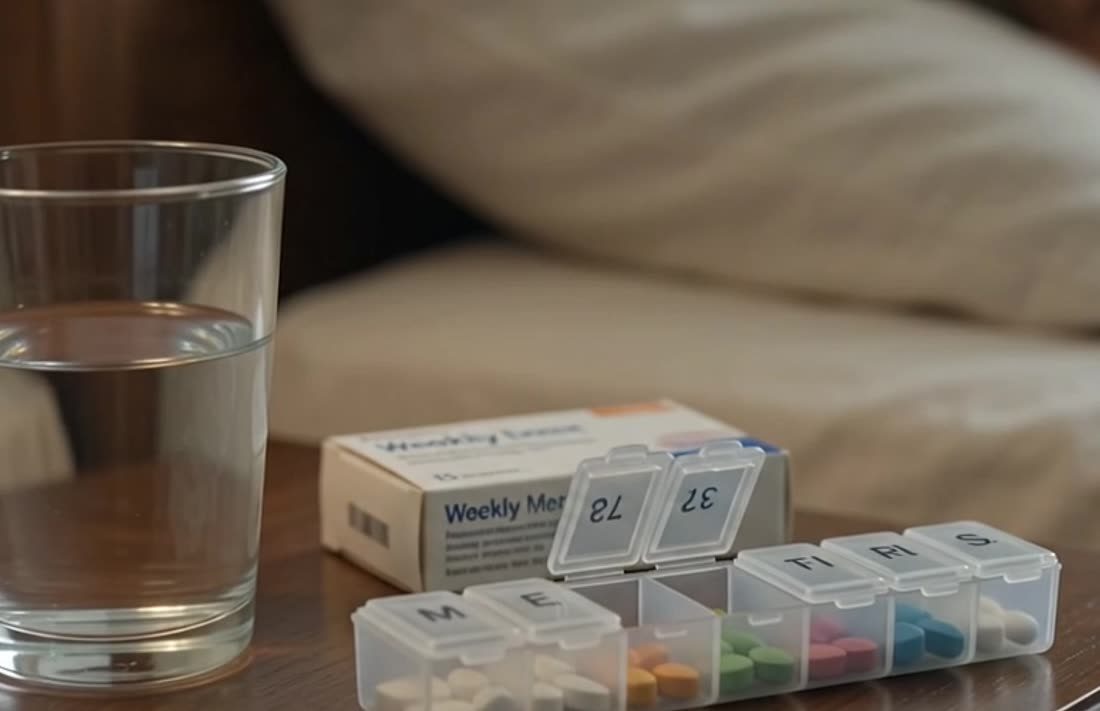
Ask any doctor what quietly undermines more treatment plans than anything else, and you'll hear the same unglamorous answer: the medication simply isn't taken. Not refused — just missed. Forgotten at breakfast, doubled by accident at dinner, abandoned when the bottle ran out and the pharmacy felt far away. The World Health Organization has long estimated that roughly half of medications for chronic conditions are not taken as prescribed — and older adults, often managing five or more prescriptions across a day, sit at the sharp end of that statistic.
For families caring from a distance, this is the most anxious question of all, precisely because it seems so small: did Mum take her blood-pressure tablet today? You can't see the pillbox from another continent. You can only ask — and asking every day, across time zones, wears down both sides of the relationship.
Why missed doses matter more after 65
In an older body, the margin for error narrows. A missed anticoagulant dose isn't an inconvenience; it's stroke risk. Skipped blood-pressure medication can produce swings that end in falls. Diabetes medication taken erratically produces the hypoglycaemic episodes that emergency departments know by heart. Researchers attribute a substantial share of hospital admissions among older adults to medication non-adherence — admissions that are, by definition, largely preventable.
And the cruelest part: non-adherence is usually invisible until it isn't. The pills sit in their bottles looking responsible. The weekly phone call sounds cheerful. The first sign a family gets is often the phone call from a hospital.
Why the usual fixes underperform
Alarms and phone reminders
An alarm tells you the time; it doesn't care whether you acted. Older adults dismiss reminder alarms exactly the way the rest of us dismiss them — reflexively, mid-task, with full intention of "doing it in a minute." The alarm's fatal flaw is that it never asks a follow-up question.
Pillboxes
The weekly pillbox is genuinely useful — it answers "did I already take it?" — but it still depends on someone opening it at the right time, and it reports nothing to anyone. A full Tuesday compartment on Thursday is information no one receives.
Daily calls from family
The gold standard emotionally, and the least sustainable practically. Time zones, meetings, children, exhaustion — life eventually wins. Worse, the medication question can slowly colonise the relationship until every loving call opens with an interrogation: "Did you take it?" Nobody enjoys becoming their parent's compliance officer.
A reminder tells. A follow-up asks. Adherence lives in the asking.
What actually works: closing the loop
Decades of adherence research keep pointing at the same handful of levers, and they are strikingly human ones:
1. The prompt must arrive in a channel the person already inhabits. Not a new app, not a new device — the place their eyes already go. For today's elders, that is overwhelmingly their messaging apps.
2. The prompt must be personal. "Time for your Amlodipine 5mg with water, Grace — after breakfast is perfect" outperforms a generic buzz because it carries the specificity of someone who knows you.
3. There must be a follow-up. This is the single most powerful and most neglected step. A gentle question five to ten minutes later — "Did you manage to take it?" — converts an ignorable notification into a small social commitment. Humans answer people; they dismiss beeps.
4. Someone must see the pattern. One missed dose is noise; three missed evening doses in a week is a signal — of a side effect, a swallowing problem, a cost worry, or early memory change. Patterns need to reach the family and, at the next visit, the doctor.
5. The tone must never scold. Shame is the enemy of adherence. Elders who feel policed start hiding misses; elders who feel cared for report them.
A practical playbook for long-distance families
Whether or not you use a service like ours, build these five habits into your family's system:
Keep one canonical medication list — names, doses, times, and purpose — somewhere every sibling can see, and update it after every single doctor visit. Half of all family medication confusion comes from three people holding three outdated lists.
Anchor doses to daily rituals, not clock times: after morning prayers, with the lunchtime news, after brushing teeth. Rituals survive where "3 PM" evaporates.
Separate the reminder role from the relationship. Let a system — human or AI — do the daily asking, so your calls can go back to being about the garden and the grandchildren.
Review the pattern weekly, not the dose daily. You want to be the person who notices "evening doses slip when she's tired," not the person who phones about one missed pill.
Bring evidence to appointments. A doctor who sees an actual adherence record — rather than hearing "I think mostly yes?" — can distinguish a failing drug from a skipped one. That distinction changes prescriptions.
Where SilaCares fits
We built SilaCares' medication loop around exactly these principles: a warm, personal reminder on WhatsApp or Telegram at the precise minute in your parent's own time zone; a kind follow-up shortly after; answers accepted by text or voice note; every response logged; misses flagged to you the same day; and the full pattern compiled into a doctor-ready report for the next appointment. It is, deliberately, the system a devoted daughter with unlimited time would run by hand.
Stop wondering. Start knowing. SilaCares' closed-loop medication care launches in October 2026 — from $10/month, no hardware, nothing for your parent to learn.
Set up their medication scheduleThis article is for general information and isn't medical advice — always consult your loved one's doctor about their medications.
Read next: The 15-minute emergency plan every family needs · Why hardware-free elder care wins